All the character names in The Tale of Genji are nicknames. So, what do they mean? - Murasaki, Yugao, Aoi, Ukifune, Kiritsubo, Asagao, Oborozukiyo, Suetsumuhana.

The Tale of Genji has a lot of characters. Murasaki, Yugao, Aoi, Ukifune….
Are you curious about where their names come from? Actually, all of their names are nicknames. They’re not their real names, and to go further, they weren’t even names given by the author, Murasaki Shikibu.
You might be thinking, "What are you talking about?" Indeed, in the translations by Waley and Seidensticker, it says things like "Yugao is ~." But let's take a look at the original medieval Japanese text. In the Yugao episode, when Genji visits his nunny's house, he meets 'a certain woman.' Eventually, he starts visiting her, and then he's attacked by a ghost in a ruined place… nowhere does the name 'Yugao' actually appear.
Yugao appears in the story as the name of a plant. It was a vine that grew in front of her house. It's a plant in the gourd family (known in English as a bottle gourd or calabash cucumber). Literally, the name means 'Evening Face'—夕 (Evening), 顔 (Face). She exchanged poems with Genji inspired by this flower.
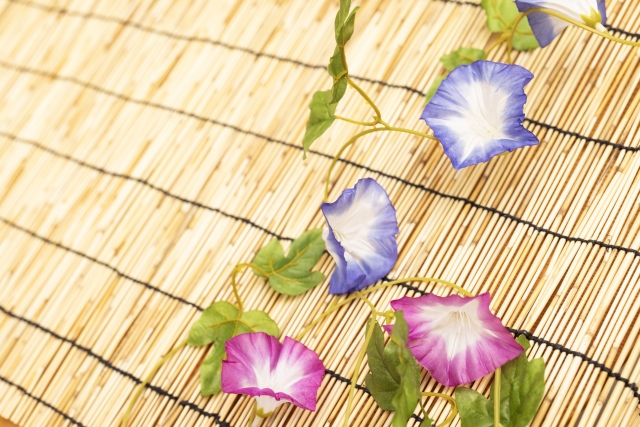
So, why did flower names end up becoming people's names? When it comes to The Tale of Genji, a passionate fandom formed right after it was published (we know this from contemporary records like the Sarashina Diary). At first, they might have talked about the characters saying things like, 'That woman who was living at Yugao house is…' This was awkward and hard to talk about. So, they just called her 'Miss Yugao.' And that's how it stuck as a way to refer to people.
| Name | Meaning | Origin |
|---|---|---|
| Kiritsubo | Paulownia Court | Paulownia tree were growing at her place. |
| Fujitsubo | Wisteria Court | Wisteria tree were growing at her place. |
| Utsusemi | Shell of cicada | Her figure as she ran off, leaving her jacket behind. |
| Murasaki | Purple | An old poem that says, 'For the sake of a single purple plant, all the grass in the field is dear.' |
| Yugao | bottle gourd | The vines growing at her place. |
| Aoi | Heartvine | Aoi Festival. |
| Rokujo | A street name in Kyoto | her address. |
| Oborozukiyo | Night with a hazy moon | The song she was humming. |
| Akashi | Place name (modern Hyogo Prefecture) | Her address. |
| Asagao | Morning glory | A poem by Genji: 'Has the morning glory I saw long ago already finished blooming?' |
| Tamakatsura(Tamakatzura) | Climbing rose | A poem by Genji: 'What kind of vine did she follow to get here?' |
| Ukifune | Flowting boat | She and Niou are riding on a boat. |
| Suyetsumu(Suyetsumuhana) | saffron flower | Her nose is the color of saffron flower. |
I also think that naming it Suyetsumu is harsh. But I believe that Murasaki Shikibu, the author of this story, originally had a very sharp and critical personality.
"Murasaki Shikibu". Where does her name come from? Despite years of research, much of her life remains a mystery. However, we can learn some things from her own diary (The Diary of Murasaki Shikibu). For instance, when she was working at the court, she was already famous as the author of The Tale of Genji.
So, the name Murasaki Shikibu is most likely derived from Murasaki no Ue in The Tale of Genji.